Sep 18, 2018 | Human Resources, Labour News
New research by Momentum Corporate has revealed that presenteeism – the phenomenon when employees are at work but not productive due to distractions – is costing South African businesses an estimated R89bn per year.

Elaine Wright, wellness strategist at Momentum Corporate, says that South African companies, already reeling from the rising cost of absenteeism on employee productivity, are losing much more due to presenteeism.
She goes on to say that the Momentum Effective Employee Index – a first of its kind in South Africa – shows that local companies lose an estimated R25bn per year to absenteeism. Around half of this can be considered to be excessive absenteeism, an amount over and above the reasonable amount expected for companies based on their size. However, this latest research suggests presenteeism is costing employers a lot more.
These results will be invaluable in helping employers to understand why employees become distracted at work, quantify the costs of presenteeism and take proactive measures to intervene and reduce its impact.
Using the South African average day rate of R405.051, it is estimated that employers are losing an average R596,566 per 100 employees per annum due to presenteeism. The results show that, on average, 27% of employees go to work but don’t always work effectively because they are distracted at some point. Plus, 33% of employees that were absent indicated they had been distracted on days they were at work prior to being absent, suggesting presenteeism can be a lead indicator of absenteeism in some cases.
Wright says that the research uncovered five key presenteeism drivers, which were ranked according to prevalence (number of employees impacted) as well as the average time that they were distracted per reason. The results are depicted below:
“Personal reasons, including sick family members, bereavement and family/relationship problems, is the top driver of presenteeism followed by financial matters, such as over-indebtedness and lack of savings for unplanned expenses. Physical and mental health distractors, such as hypertension, headaches, flu as well as depression, burnout and mental exhaustion, are also serious distractors in the workplace.”
Finance and other business services and Agricultural are the industry sectors most heavily impacted by presenteeism, with a presenteeism prevalence of 30.0% and 29.8% respectively. Employees in the mining and electricity, gas and water supply industries lost the most productive time due to presenteeism, values of 7.0 and 6.8 days per employee per month respectively.
Wright says, “There are a number of proactive measures employers can take to reduce the impact of these presenteeism drivers. For example, an effective Employee Assistance Programme can be instrumental in helping employees to cope better with their personal issues and improving emotional health.

Feb 8, 2018 | Labour News
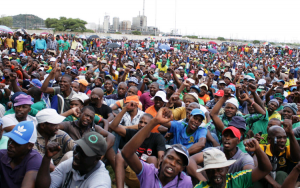
Parliament is currently considering amendments to the Labour Relations Act (LRA), which, if passed, will dramatically alter the constitutional right to strike. The justification the Department of Labour provides in the impact assessment for the amendments is that strike action and, particularly, violent and protracted strike action is at an all-time high.
However, this assertion is not borne out by the department’s own data on strikes. In fact, the impact of these amendments is likely to increase, rather than decrease unprocedural strike action.
While it is true that the number of work stoppages has increased over the past decade, the increase has not been dramatic (see Figure 1).
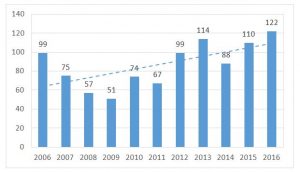
FIGURE 1. NUMBER OF WORK STOPPAGES IN SOUTH AFRICA 2006-2016.– Source: Department of Labour Annual Industrial Action Reports
But using the number of work stoppages as an indicator of industrial action is a very imprecise measure. More commonly, the number of working days lost is used as a more accurate measure of industrial action.
Figures from the department’s annual industrial action report show that, over a 10-year period, there has been a decline in the number of working days lost, even including the number of working days lost during the 2010 public sector strike and the 2014 platinum strike (see Figure 2).
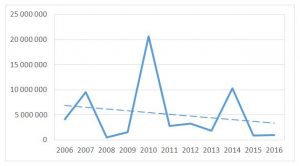
FIGURE 2. NUMBER OF WORKING DAYS LOST 2006-2016– Source: Department of Labour Annual Industrial Action Report
The assertion that strikes are increasingly protracted is, again, not supported by the evidence. According to the department’s 2016 industrial action report, the quarterly analysis shows that more than two thirds of strikes lasted between one and five days. Only a very small number of strikes lasted more than 30 days. Based on the data supplied by the department there is no evidence that protracted strikes are a particularly prominent phenomenon within the South African industrial relations landscape.
What of the question of strike violence? Again, there is no clear evidence to support the claim that violent strikes are a particularly prominent or increasing phenomenon. The evidence presented by the department to substantiate increasing strike violence is based on secondary data compiled from media reports from the South African Institute of Race Relations (SAIRR), which look at the number of fatalities that have occurred through strikes. Media data is predisposed to reporting violent incidents and thus provides a flawed and inherently biased source of data.
“There is no evidence that protracted strikes are a particularly prominent phenomenon within the South African industrial relations landscape”
A much more reliable source of data, although not without its limitations, would be the number of incidents recorded within SA’s Incident Registration Information System (Iris) compiled by public order police within the South African Police Service. Myself and a team of researchers at the University of Johannesburg have worked extensively with this data and found that, between 1997 and 2013, 86% of all labour-related protests were orderly. Based on our understanding of more recent data there is no indication to suggest that the number of disorderly labour-related protests has significantly increased.
The evidence marshalled by the department can be described as weak, at best. What’s worse is that the amendments are likely to increase the problems they seek to solve.
The amendments introduce a raft of measures that will delay and inhibit the rights of workers to embark on protected strike action, through increasing the number of days for conciliation from 30 to 35 days, the introduction of secret ballots, and advisory arbitration. Each of these changes provide employers with more tools to disrupt strike action without engaging with the substantive issues raised by workers.
“There is no indication to suggest that the number of disorderly labour-related protests has significantly increased”
The compulsory introduction of secret ballots individualises an otherwise collective decision, but more fundamentally it takes away the ability of workers and unions to determine their own, internal, democratic processes. Furthermore, it provides employers with the opportunity to interdict strikes before they have even begun, based on legal challenges to the reason for which the secret ballot was conducted.
Advisory arbitration presents a number of additional challenges as unions would now be expected to involve experts in the deliberations of the advisory arbitration panel. This means that collective bargaining will become more technical in character and far removed from the control and direction of workers. Though the advisory arbitration process does not automatically interrupt or suspend the strike, workers and their unions will nevertheless have to contend with another bureaucratic procedure when exercising the right to strike. Unions are forced to take account of the advisory arbitration and its deliberation, even when they do not support it.
The introduction of new procedural and technical hurdles in exercising the democratic right to strike may, as experience from the implementation of the Regulations of Gatherings Act shows, actually increase the number of unprotected strikes. Evidence shows that when the constitutional rights to protest are frustrated by onerous administrative requirements, the likelihood is that citizens will disengage from the formal process and head to the streets anyway. The amendments to the LRA are likely to end up with the same result.
If the amendments were serious about tackling strike violence they should have addressed the cause: the use of scab labour. None of the proposed amendments will solve this problem, instead they will only frustrate workers through increasingly bureaucratic processes that can be endlessly subjected to legal challenges from employers.
Even the International Monetary Fund recognises that suppressing the right to strike leads to declining wages and increasing inequality. Given that SA is the most unequal country in the world, law makers should be giving serious thought as to how they can protect the rights of workers.
• Runciman is a senior researcher at the University of Johannesburg and a management committee member of the Casual Workers Advice Office
Nov 28, 2017 | Labour News
When should the Labour Court prevent an employer from exercising its right to take disciplinary action against employees? In Booysen v Minister of Safety and Security [2011] 1 BLLR 83 (LAC), the Labour Appeal Court stated as follows:

“… the Labour Court has jurisdiction to interdict any unfair conduct, including disciplinary action. However, such an intervention should be exercised in exceptional cases. It is not appropriate to set out the test. It should be left to the discretion of the Labour Court to exercise such powers having regard to the facts of each case. Among the factors to be considered would in my view be whether failure to intervene would lead to grave injustice or whether justice might be attained by other means. The list is not exhaustive.” [own emphasis]
On 18 October 2017, in the matter of Golding v Regional Tourism Organisation of Southern Africa and Others [case no J2501/17], the Labour Court provides guidance on what constitutes “exceptional circumstances” when interdicting disciplinary proceedings.
On 4 September 2017, the employer’s board of directors purportedly resolved to institute disciplinary proceedings against the employee. The employee instituted urgent proceedings to stay the disciplinary action pending a High Court application to declare unlawful or invalid, and set aside, the resolutions taken by the board.
The requirements for interim relief of this nature are (i) the existence of a prima facie right, (ii) the apprehension of irreparable harm, (iii) the absence of alternative relief and (iv) the balance of convenience.
The employee submitted that should the disciplinary hearing proceedings continue and he be dismissed, the outcome of the High Court application would become moot and purely academic.
Regarding alternative relief, the employee submitted that the Labour Relations Act 66 of 1995 (LRA) does not make provision for applications to challenge the unlawfulness of resolutions instituting disciplinary proceedings. The Court disagreed with the employer’s contention that even if dismissed, the employee can challenge his dismissal at the CCMA.
Furthermore, the employee submitted that should the relief be granted, the employer will not suffer any undue prejudice as it would still have recourse to discipline him after the High Court hearing.
The Court held that whilst the employee may have remedies in the LRA, this will not address the injustices that he will suffer should the High Court find the resolutions unlawful and invalid.
The Court further held that its failure to intervene would result in an injustice that would not be addressed by any subsequent unfair dismissal remedy and that the employee had thus shown that exceptional circumstances exist for the Labour Court to intervene and grant the relief sought.
The judgment highlights one set of exceptional circumstances. There are bound to be other examples. The principle remains, though, that the court will not lightly interfere with an employer’s prerogative to discipline, even dismiss, staff. Our employment legislation, tribunal and courts provide more than adequate remedy to employees aggrieved by the conduct of employers.
In exceptional circumstances, though, the court will come to the assistance of an employee where these remedies may provide cold or academic comfort only.
Nov 9, 2017 | Labour News

Nov 1, 2017 | Labour News
The Department of Labour Inspection and Enforcement Services (IES) branch will host a session on employment equity (EE) with private and public sector employers and organised labour to establish why it is difficult to comply with EE legislation.
Labour Deputy Minister iNkosi Phathekile Holomisa will deliver a keynote address at the breakfast session on Monday.
The session, which will be held under the theme, ‘We strive for transformation’, is part of the department’s IES branch advocacy sessions.
The advocacy will enable the department to come up with strategies and interventions that will assist in transforming the workplaces going forward.
The goal of the EE breakfast session is to:
- strengthen EE implementation and compliance mechanisms;
- foster redress transformation for economic development of the country; and
- provide an outcome on the DG Reviews conducted on the 50 JSE Listed companies.
IES Branch is currently as part of its work plan, conducting Director-General Reviews to designated employers where 72 JSE Listed Companies operating in different sectors were identified as subject of reviews.
Thus far, 50 companies that have been reviewed, none was found to be compliant and as such DG Recommendations were issued with expected time frames of compliance and others were referred directly for prosecution for failure to prepare Employment Equity Plans.
The companies were in Finance and Business sector, Electricity, Gas (Chemical) and Water, Construction, Manufacturing, Retail & Motor Trade, Catering and Accommodation Sector.
During the last financial year, 2016/17, the Branch conducted a similar session in Cape Town where EE Managers were invited to engage on EE issues and the lack of transformation in their respective workplace as they are mandated to transform as per section 24 of the Act.
The IES plans to extend its advocacy nationally.
The breakfast session is targeting heads of Departments, Chief Executives and Managing Directors of Companies; organised business and employers, Human Resources and Practitioners, EE Forum members, assigned senior EE managers and community constituencies, among others.
The EE Act is currently a subject of discussion at Nedlac ahead of amendments to give teeth to legislation to ensure compliance.
Oct 3, 2017 | General, Labour News
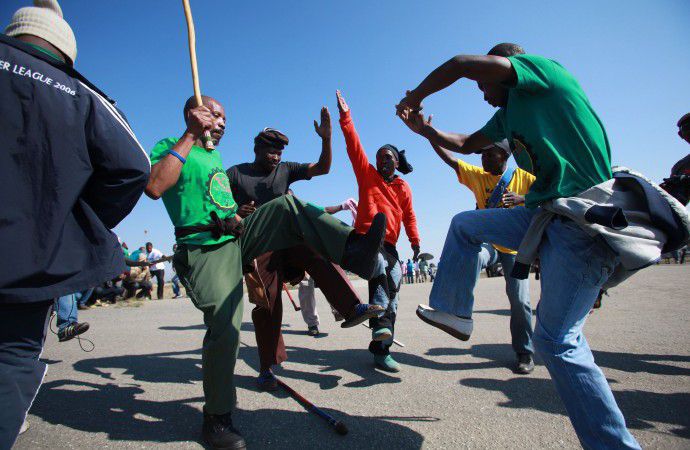
The South African economy lost a total of 946 323 working days as a result of 122 work stoppages in 2016
The Department of Labour has warned that continuous labour protests have cost the sector and the country’s economy millions of rands.
The department released it’s 2016 annual Industrial Action report, in which it highlights the findings of the strike incidents.
It said the South African market lost a total of 946 323 working days as a result of 122 work stoppages, which represents a 4,7% increase in working days lost when compared to the 903 921 days lost in 2015.
“In terms of wages lost, the South African labour economy lost approximately R161 million due to work stoppages in 2016, as compared to R116 million in 2015. This reflects an increase of 38,8% in wages lost due to work stoppages,” it said.
The report highlighted that more work stoppages were experienced during the strike seasons – the second and third quarters of the year.
According to the department, strikes in a company only were predominantly higher, contributing to 56% of strikes that took place in 2016, followed by those workers who were locked out, at 26%.
“Most of the work stoppages were due to wages, bonus and other compensation demands. The time-loss ratio was at 59 working days lost per 1 000 employees,” it said.
A total of 7,6 million working hours were lost in 2016 as compared to a total 8,2 million working hours lost in 2015. There were 90 228 workers involved in labour disputes in 2016, the lowest figure since strike records were first captured in 2013.
Gauteng and KwaZulu-Natal experienced more strikes in all the four quarters of 2016.
The department said the strike report remains a useful piece of up-to-date information for various stakeholders, including government departments, unions, employers, business, international organisations, research institutes, NGOs and students.
It further provides a detailed account of companies affected by work stoppages and disaggregates information by province, duration, industries, nature and reasons for strikes.
The department stressed that in order to reduce strike incidents related to wage demands, possibilities of increasing minimum wages to address poverty and inequality and expanding provision for retirement savings for low-income workers will become a sharp focus in the future.
“South Africa needs to find a solution for the seemingly faltering bargaining structure. Government, unions and business have an important role to play in order to maintain a stable labour force and fair labour practices that will attract investors and inspire economic growth in the long run.”
Courtesy : www.destinyconnect.com